

Lessons from the INHERIT study visit in Cyprus on how BIM and Virtual Reality are transforming historic building renovation
What happens when tradition meets cutting-edge technology?
The INHERIT study visit to Nicosia, Cyprus, on 18 March 2025, offered an inspiring glimpse into the future of heritage preservation. Here, partners explored how digital tools like Building Information Modeling (BIM) and Virtual Reality (VR) are transforming the way historic buildings are renovated, making it possible to protect cultural identity while improving energy performance.
Launched after an open call in April 2024, the INHERIT peer-learning study visits bring together partners from across Europe to exchange knowledge, discover local initiatives, and learn from innovative practices that combine heritage preservation with energy efficiency. The Cyprus visit marked the very first step in this journey of shared learning.
On 18 March, representatives from the Polish pilot in Gdynia – including FASADA and the Energy Department of the Gdynia City Hall – took part in the visit. The group explored a listed historic building located near the medieval walls of Nicosia, adjacent to the Arab-Ahmet district. Built in 1863, it was initially a British cavalry club before being converted into barracks for the Danish-Canadian military stationed in Cyprus.
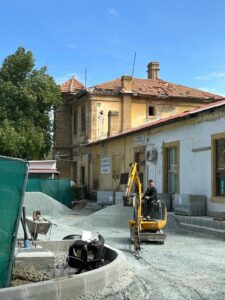
The building’s architecture combines colonial elements such as a stone turret, gable roof, and pediments with traditional Cypriot features like an inner courtyard and a porticoed entrance. The structure includes load-bearing limestone walls, wooden partitions, adobe walls, and a mix of interior finishes, with a sloped roof and wooden floors adding historical character.
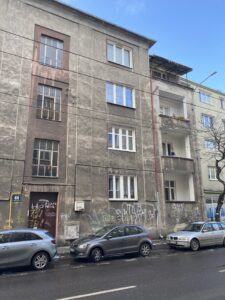
In the Polish pilot in Gdynia, INHERIT is working on an optimal renovation strategy for the social residential building at 44 Warszawska Street. With the support of the City of Gdynia and its Municipal Building and Premises Authority, the building is serving as a testing ground for solutions that reconcile cultural heritage with energy efficiency.
One of the key innovations is the creation of a digital twin of the building through BIM. This detailed model documents historical elements, enables exploration of different renovation options, and allows stakeholders to simulate them in VR before works begin.
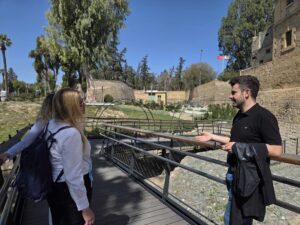
In Cyprus, the partners had the chance to see these technologies in action, visiting historic sites where BIM and VR are already being used to guide sensitive renovations.
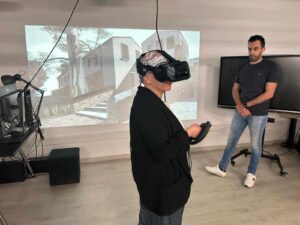
In particular, VR was used to visualise how the building would look after renovation, showing how planned works and smart solutions would affect its functionality while preserving its historical value as much as possible. This immersive presentation was used to communicate the concept to decision-makers, making it easier to evaluate the proposed actions.
The BIM model was developed to support energy analyses. It was exported to a gbXML file and, using appropriate software, energy simulations were performed for different scenarios. Notably, the definition of BIM used in this Cypriot case differs from that adopted in the INHERIT project, where BIM functions mainly as a source of detailed information about the building’s elements.
The exchange sparked valuable discussions on how digital tools can support not only conservation, but also modernisation that respects cultural values.
For the Gdynia pilot, the visit was a powerful source of inspiration. The knowledge and experiences gained will help adapt international best practices to local needs, ensuring that interventions at Warszawska Street – and future heritage projects in the city – are both energy-efficient and respectful of their architectural identity.
This first stop in Cyprus embodied the true spirit of INHERIT: creating a European learning community where local pilots benefit from shared expertise, and where innovation and tradition work hand in hand to shape a more sustainable future for historic buildings.
This study visit also highlighted the diverse applications of AR/VR technologies used by the Cyprus Institute. Participants explored projects that demonstrated how these tools support cultural heritage preservation, energy efficiency, education, archaeological research, and public outreach. The visualisation of renovation scenarios was particularly impactful, making proposed solutions easier for a wide range of stakeholders to understand and engage with. This approach supports decision-making, strengthens public acceptance, and can facilitate fundraising efforts.
The visit once again demonstrated the strength of peer learning. By connecting local heritage projects across Europe, INHERIT enables knowledge, tools, and innovation to flow across borders, helping small-scale initiatives set new standards for sustainable cultural heritage preservation.