

Lessons on heritage preservation and urban revitalisation from the INHERIT study visit in Bologna, Italy
Historic walls often have stories to tell and the Baraccano complex in Bologna, Italy, speaks of centuries of social care, education, and civic life. On 4 June 2025, INHERIT partner CARTIF, responsible for the Spanish pilot site, visited this remarkable site to explore how heritage buildings can be revitalised through community engagement, sustainable practices, and digital innovation.
On the same day, two other INHERIT partners, ELLET and RPR, went on a study visit to Ravne na Koroškem, Slovenia, further expanding the project’s understanding of management and restoration of cultural heritage buildings across Europe.
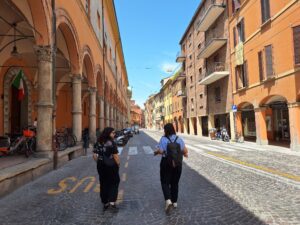
Located in Bologna’s Santo Stefano district, Baraccano dates back to the 15th century, originally serving to support and educate disadvantaged young women. The complex includes the Sanctuary of Santa Maria del Baraccano and the former Conservatorio delle Putte, and features iconic architectural elements such as the Voltone del Baraccano (1497), forming part of Bologna’s UNESCO-listed portico system.
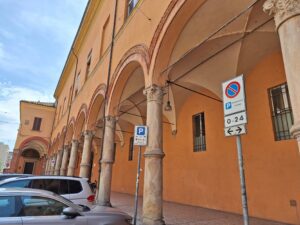
In recent years, the complex has undergone a successful transformation into a vibrant community hub. Today it hosts the Casa delle Associazioni, accommodating cultural, social, and educational activities that have reactivated the site while fully respecting its heritage value. This adaptive reuse demonstrates how historic buildings can respond to contemporary community needs without compromising their identity.
The regeneration of Baraccano is closely linked to the wider renewal of the surrounding neighbourhood. Once considered a marginal and partially abandoned area, the district has benefited from coordinated public and private interventions that improved public spaces, infrastructure, and social cohesion, turning it into a more inclusive and dynamic part of the city.
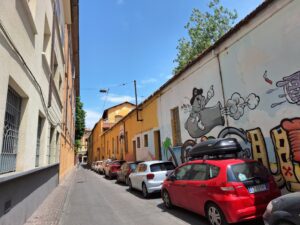
This dual focus on heritage conservation and urban revitalisation, guided by tools such as the Italian Carta del Rischio (which can be translated in English as “Risk map of the cultural heritage”), makes Baraccano a highly relevant case study for INHERIT.
It illustrates how preventive conservation can be integrated into broader social and urban strategies through early stakeholder alignment, involving municipalities, academic institutions, and civil society in shaping a shared long-term vision.

For CARTIF, the visit offered valuable insights for the renovation of the Monastery Monastery Ntra. Sra. del Prado in Valladolid. INHERIT’s work in the Spanish pilot site aims to optimise overall energy performance while preserving historical authenticity, focusing on cost-effective solutions and minimal disruption. The renovation will leverage interactive screens, AR/VR interfaces, and a digital twin, alongside Heritage Building Information Modelling (H-BIM) supported techniques based on a thorough technical inspection of the built heritage in line with European regulations.
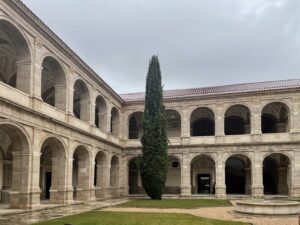
Particularly relevant for the Spanish pilot site is the methodological framework adopted at Baraccano, which combines Geographic Information System (GIS), H-BIM, and risk-informed approaches. The integration of building-scale H-BIM with urban-scale GIS highlights the importance of linking detailed conservation data with territorial planning. While this approach is conceptually transferable, its application requires strong institutional collaboration, technical capacity, and adaptation to national regulatory and digital contexts.
Overall, the Baraccano complex shows how heritage-led regeneration, supported by digital tools and inclusive governance, can sustain not only historic buildings but also cultural and social continuity, offering valuable inspiration for INHERIT pilot sites and future interventions across Europe.