

Bouygues Construction hosted an INHERIT workshop in Paris that brought together architects, construction professionals and public authorities to look at how heritage preservation can be reconciled with performance, affordability and social value.
How can heritage buildings be converted and renovated without losing what makes them valuable? This was the question behind the workshop “How can heritage buildings be converted and renovated?”, organised by Bouygues Construction in Paris on 1 October 2026 as part of the INHERIT project. It was also the first dissemination workshop organised by the INHERIT French pilot.
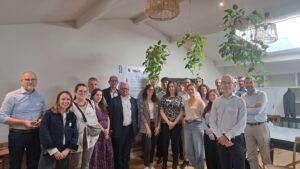
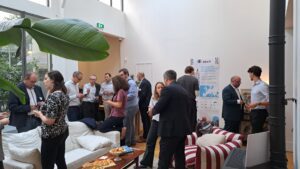
The event brought together 32 participants from across the heritage renovation value chain: architects and heritage experts, real estate and construction professionals (including Bouygues Construction and Linkcity), public-sector representatives, researchers, and innovation and sustainability specialists.
From project vision to practice
Xavier Gauvin (Bouygues Construction, R&D and Innovation Division) opened the workshop with an overview of INHERIT. He covered its objectives, the context in which it was developed, and the services and tools it offers to support the adaptation of heritage buildings.
Two architects then shared lessons from ambitious rehabilitation projects. Philippe Prost (AAPP), winner of the 2022 Grand Prix National de l’Architecture, presented the rehabilitation of the Fort des Trois Têtes in Briançon, a project won with Linkcity Sud-Est. Cyril Trétout of the ANMA agency presented the rehabilitation of the Hôtel-Dieu site in Rennes.
Caroline Bouteloup, Head of the Renovation Division at CSTB, introduced a decision-support tool for heritage renovation. Xavier Gauvin then presented the tool developed within INHERIT. It is designed to help project stakeholders discuss, at an early stage, how acceptable different renovation solutions are, weighing technical, budgetary and regulatory considerations.
The discussion also covered how to work with the Architectes des Bâtiments de France (ABF).
Key takeaways
Participants showed strong interest in practical methods that make complex renovation choices more transparent and more collective. A recurring message was that heritage renovation should not be judged on energy performance alone. Decisions need to balance conservation requirements, whole-life costs, carbon impact, usability and accessibility, and technical feasibility.
The case studies showed that heritage-led regeneration can create architectural, territorial and social value when clients, designers, heritage authorities and delivery teams agree on goals early in the project. Participants saw the INHERIT approach as relevant to these early discussions and trade-offs, because it gives the dialogue a structured, evidence-based starting point.
Photo credit: Bouygues Construction