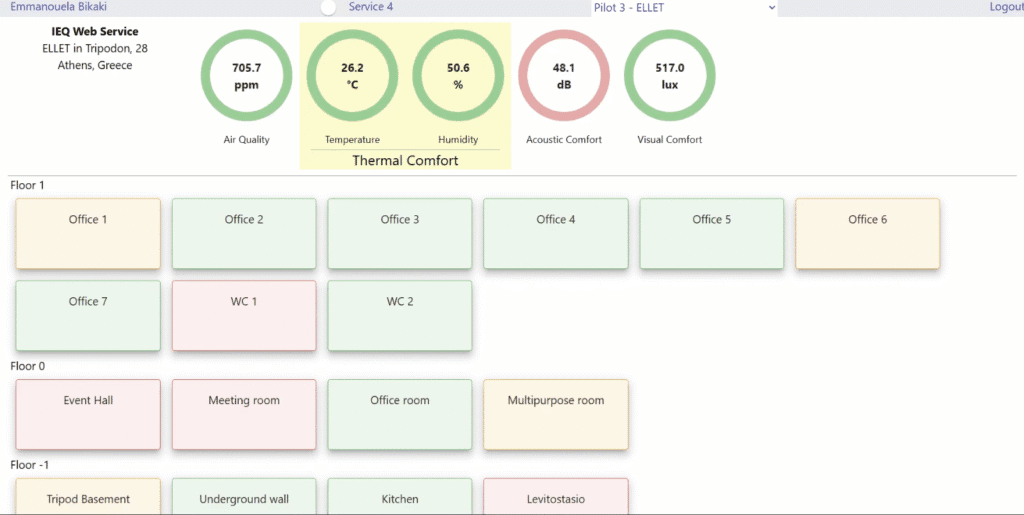
Indoor environmental quality & thermal comfort optimisation
Data-driven recommendations to improve indoor conditions for building occupants.
Maintaining a healthy, comfortable indoor environment in cultural heritage buildings is a delicate balance between occupant well-being and preservation requirements. This service provides a web-based application that continuously monitors environmental conditions and offers data-driven recommendations to improve comfort while protecting historic structures.
Key Features
-
Real-time environmental monitoring
Track temperature, humidity, air quality, lighting, and noise as conditions change.
-
Integrated user feedback
Combine sensor readings with occupant and facility manager input for a fuller comfort assessment.
-
Automatic anomaly detection
Use data-driven algorithms to highlight irregular or concerning environmental shifts.
-
Historical pattern analysis
Reveal recurring trends and problem areas over days, weeks, or seasons.
-
Recommendations engine
Generate actionable proposals, ranging from operational and behavioural adjustments to structural interventions, tailored to the type and severity of detected comfort deviations.
-
Interactive visualisation dashboard
Explore both live conditions and historical data through an intuitive interface.
-
Modular, scalable architecture
Deploy easily across heritage sites and integrate with existing systems.
Benefits
-
Ensures comfortable, healthy conditions for building occupants
-
Optimises comfort without compromising cultural or structural integrity
-
Translates complex data into practical recommendations
-
Every data point is linked to a specific room and building context
-
Supports facility teams in identifying, prioritising, and addressing IEQ issues quickly
-
Designed for replication across multiple heritage sites and climates
How it works
The service provides a comprehensive view of indoor comfort by combining real-time sensor data with direct feedback from building occupants and facility managers. It monitors temperature, humidity, CO₂, lighting, and noise across different rooms, presenting conditions through a clear, web-based interface.
Users can quickly see which spaces are within healthy ranges, explore live room-level data, and review trends over time to understand when and where conditions drift from optimal levels. Advanced analytics visualise patterns and detect anomalies, linking environmental shifts to occupancy behaviour, building use, or external factors. Based on these insights, the system proposes targeted, preservation-aware measures, from simple ventilation adjustments to more structural interventions, drawing on the INHERIT Hub of Measures.
Built on a layered architecture with PostgreSQL for secure data storage, Python-based analytics for detection and evaluation, and a responsive React interface for intuitive interaction, the platform ensures traceable data flows, seamless updates, and scalable deployment across heritage sites.